Alviscan saves healthcare staff in UMC Groningen a significant amount of time

Alviscan saves healthcare staff in UMC Groningen a significant amount of time

The University Medical Center Groningen, like many other hospitals, is facing major challenges. Work pressure in healthcare is increasing, while staff shortages continue to grow. At the same time, the hospital aims to maintain high-quality care and keep the work appealing for its staff. That is why UMCG is heavily investing in innovation.

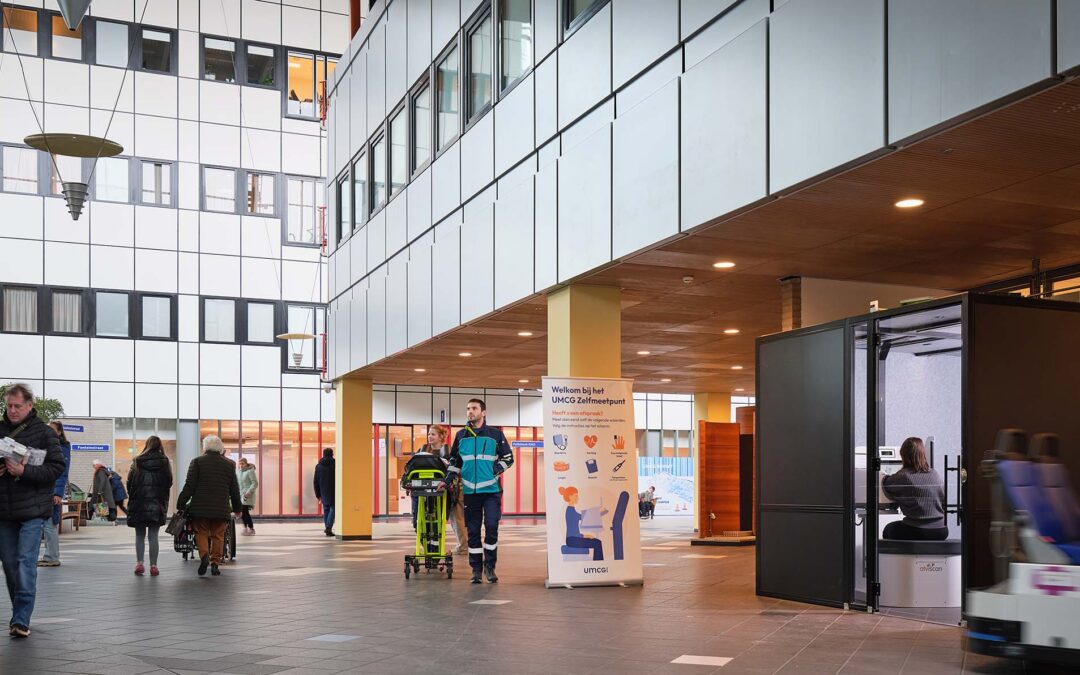
“The self-measurement kiosk is one of the solutions we began exploring,” says Marjolein Blaauw, Project Manager for Data & Digitalization. “We contacted several suppliers and visited other hospitals that already had a self-measurement kiosk in place. Following this, we tested two kiosks from different suppliers at our own site.

Testing in rotation

Elmar Boelkens, staff advisor for Innovation, was involved during the pilot fase. For a month, the self-measurement kiosks were tested alternately at the preoperative screening outpatient clinic and in the surgery department for same-day admission patients. After a thorough evaluation, UMCG ultimately chose Alviscan. “The service level provided by Alphatron was what really made the difference for us,” says Boelkens. “The communication, their willingness to think along with us, the support, and their ‘just get it done’ mentality, made the collaboration very pleasant.

“During the pilot phase, we surveyed many people. About 70% were enthusiastic about self-measurement. All in all, quite progressive for this region.”

Elmar Boelkens, staff advisor for Innovation, UMCG (NL)

Alviscan as part of the solution

Innovation will remain a top priority at UMCG, regardless. Boelkens explains: “At our University Medical Center, innovation is a common thread. We continuously look at how things can be done more efficiently or better, and how we can support our healthcare professionals as much as possible. The workload in healthcare is high, and we are facing staff shortages due to an aging population. In Groningen, this may be even more pronounced than in the rest of the country.”

Saving 3 to 5 minutes per patient

There are now three Alviscan units in the hospital; the internal medicine department also has its own self-measurement kiosk. Blaauw explains: “That department wasn’t part of the pilot project, but they quickly saw the benefits. The device takes over tasks that were mainly performed by physicians, so they were very interested.”

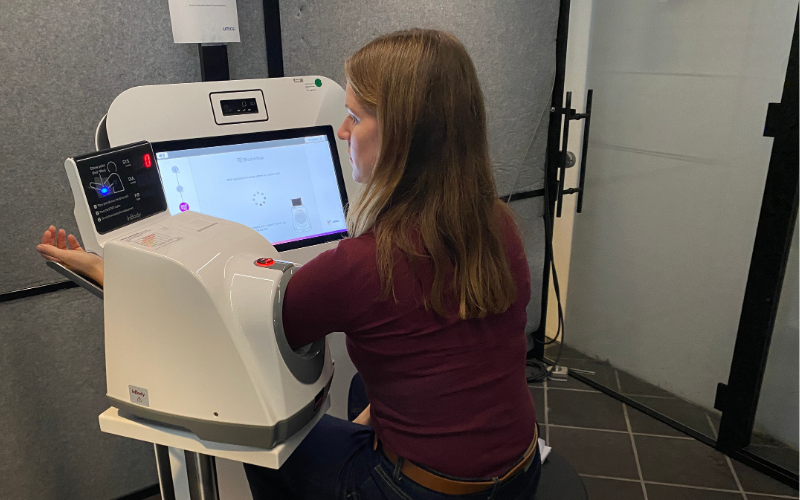
With Alviscan, patients measure their own vital signs, and all data is automatically recorded in EPIC, the electronic patient record system. This saves healthcare staff approximately 3 to 5 minutes per patient. In the preoperative screening department, this could translate into a reduction of up to 1.5 FTE. However, this time saving is not a goal by itself. Boelkens explains: “By allowing Alviscan to take over routine measurements, medical assistants have more time to truly focus on the patient. That personal attention remains extremely important to us. We are therefore exploring how Alviscan can be implemented across more departments, enabling both healthcare professionals and patients to benefit as much as possible.”

“The benefits of Alviscan are hard to express in exact monetary terms,” Boelkens adds. “It’s more about softer gains, such as increased efficiency, more time for patients, greater job satisfaction for staff, and consequently reduced absenteeism.”

“The self-measurement kiosk takes over tasks in internal medicine that were mainly performed by physicians.”

Marjolein Blaauw, Project Manager Data & Digitalization, UMCG (NL)

Alviscan saves healthcare staff in UMC Groningen a significant amount of time

Deventer Hospital opens self-measurement point: innovation that eases the pressure on healthcare

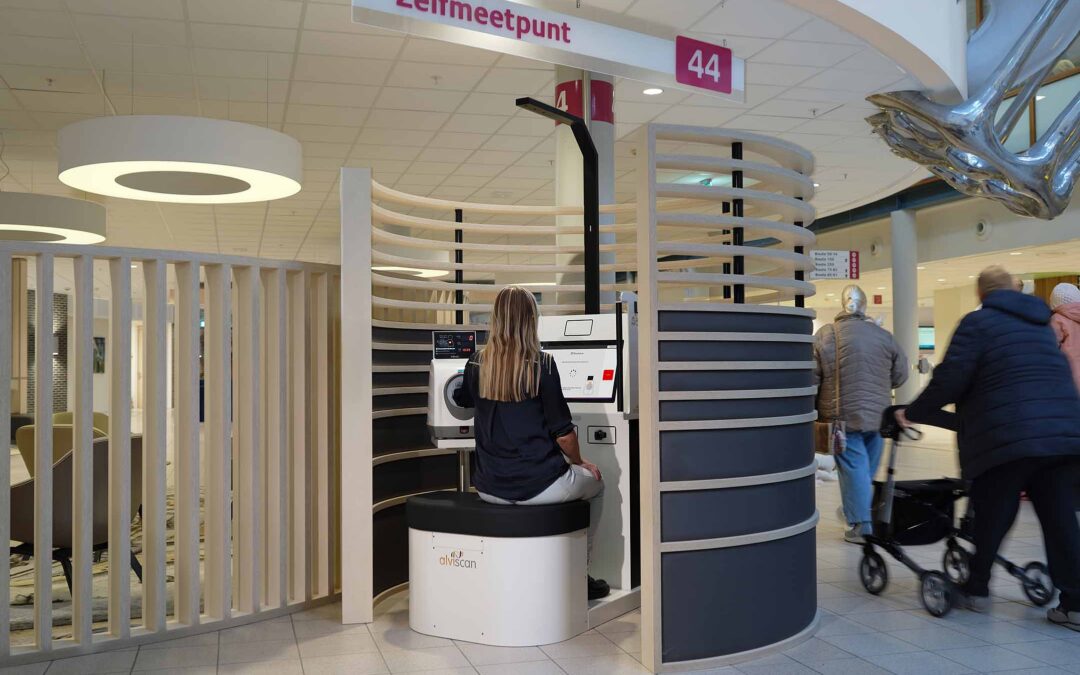
Innovation plays a key role in the strategy of Deventer Hospital. From this vision, an Alviscan has been installed: a self-measurement point where patients can independently take their measurements. The self-measurement point is located in the main hall and is used by patients from four outpatient clinics: nephrology, diabetes, pulmonary function, and neurology.

“Self-measurement fits well within our vision,” says Irene Wischhoff. She was initially involved in the innovation project as an information advisor and later became project leader, supervising the project together with IT architect Remco van Wijhe. “We want to give patients more control, while also easing the workload on our staff. When patients measure their own vital signs, it saves a lot of time for healthcare professionals in the outpatient clinics.”

Different measurement protocols

Alviscan is fully preconfigured to meet the requirements of the project group. A connection with the Electronic Health Record (EHR) HiX has been implemented, allowing measurement data to be stored directly in the patient record. In addition, Alviscan automatically selects the correct measurement per patient based on the type of outpatient appointment.

“The pulmonary function department requires a saturation reading, while that is hardly relevant for the diabetes clinic. We therefore use two separate measurement protocols and can easily expand to a third if needed. Having that flexibility is very welcome.”

Irene Wischhoff, Information Advisor, Deventer Hospital (NL)

Without a pilot

Deventer Hospital chose to implement Alviscan directly, without a prior pilot. “We consider ourselves fast followers,” explains Wischhoff. “Alviscan has already proven its value in other hospitals, so from our perspective, a pilot was not necessary.” Staff were, however, given a week to try out Alviscan as a stand-alone system. Van Wijhe adds: “This allowed everyone to experience self-measurement for themselves and understand what the patient goes through.”

Usage and numbers

The project group closely monitors the introduction of Alviscan during the initial phase across all areas, including reviewing system data. Wischhoff explains: “For example, we want insight into how often a doctor repeats a measurement, or how many patients skip the self-measurement point. There can be various reasons for this. By understanding them, we can respond appropriately and help reduce any feelings of anxiety or hesitation. Our goal is to encourage both patients and healthcare professionals to make full use of this innovation.”

Trust

Looking back, Wischhoff and Van Wijhe are very satisfied. “I think we approached it well,” says Wischhoff. “Internally, we involved as many stakeholders as possible in the process, not only healthcare providers, but also the Patient Council, facility services, the infection prevention team, the marketing and communications department, and volunteers. We wanted to be very careful in that regard.”

The collaboration with Alphatron was also very positive, Van Wijhe explains. “Compliments to Alphatron; you can tell they really built on their experience from the first hospitals. There was a tight project schedule, regular meetings, excellent documentation, and short communication lines. They also actively thought along with us when we ran into problems. Communication was very smooth, which really helped build trust.”

“Self-measurement fits well within our vision. We want to give patients more control, while also easing the workload for our staff. When patients measure their own vital signs, it saves a lot of time for healthcare professionals in the outpatient clinics.”

Irene Wischhoff, Information Advisor, Deventer Hospital (NL)

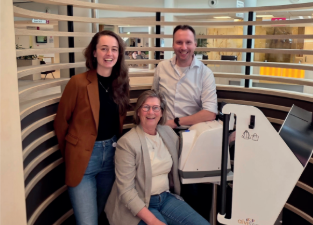
A successful three days at DMEA 2026!

A successful three days at DMEA 2026!

From 21 to 23 April, Alviscan was present at DMEA 2026 in Berlin on the stands of our partners Alphatron Medical (Germany) and CANCOM (Austria).

DMEA is Germany’s leading trade fair for digital health, bringing together more than 20,500 professionals from healthcare, IT, and policy. Throughout the event, Alviscan was demonstrated at both partner stands and generated strong interest from hospital professionals across the DACH region.

Beyond the demonstrations, the event was marked by many valuable conversations with healthcare professionals, IT leaders, and decision-makers. Discussions focused on practical use in daily clinical workflows, integration into existing hospital systems, and the growing need for solutions that support efficiency and patient empowerment.

Check out the video from CANCOM about Alviscan!